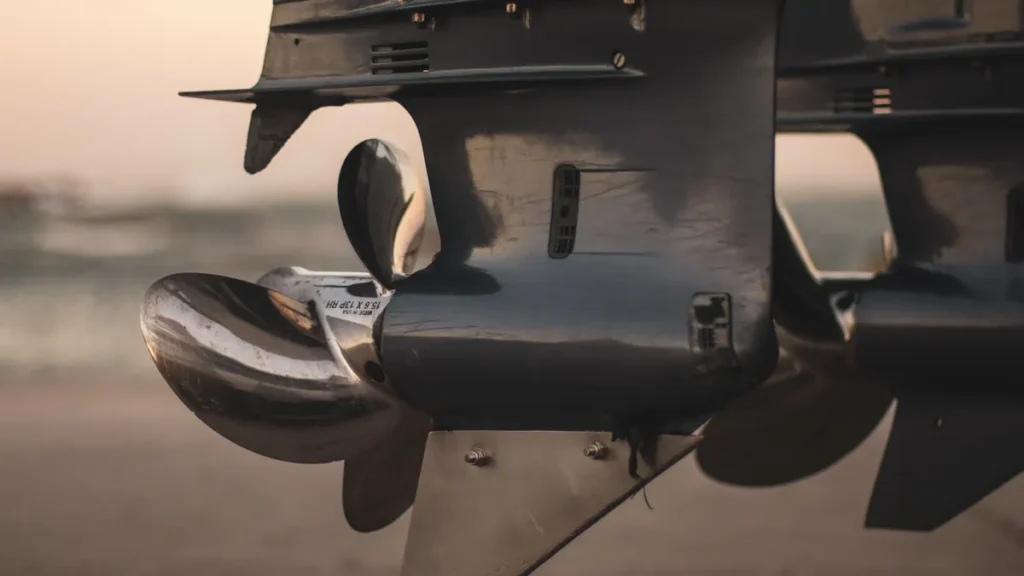
Five brands list 20 horsepower outboard motors on their US sites today: Mercury, Yamaha, Suzuki, Tohatsu and Honda. All five are two-cylinder four-strokes rated at 20 hp, which converts to 14.9 kW. The shared rating hides real differences in weight, displacement, fuel system and rigging options, and those are what decide which one fits your boat.
Every figure below comes from the brand’s own spec page or brochure, checked on 21 Nov 2026. Where a brand page leaves a value out, the table says “not listed” rather than borrowing a number from a dealer listing.
20 horsepower outboard motors compared, brand by brand
| Model | hp | kW (converted) | kW as listed | Engine and fuel system | Displacement | Cylinders | Weight as listed | Shaft lengths | Start | Tiller / remote |
|---|---|---|---|---|---|---|---|---|---|---|
| Mercury FourStroke 20 EFI | 20 | 15 (14.9) | 15 | 4-stroke SOHC, EFI | 333 cc (20.3 cu in) | 2 | 99 lb (45 kg), lightest version | 15, 20 in | Manual or electric | Tiller or remote |
| Yamaha F20 | 20 | 15 (14.9) | not listed | 4-stroke SOHC, EFI | 362 cc as listed (see findings) | 2 | 126 to 146 lb (57 to 66 kg), with prop | 15, 20 in | Electric and manual | Tiller; remote not listed |
| Suzuki DF20A | 20 | 15 (14.9) | 14.7 | 4-stroke SOHC, EFI (Lean Burn) | 327 cc (20.0 cu in) | 2 | 97 lb manual, 105 to 108 lb electric | 15, 20 in | Manual or electric (20 in: electric) | Tiller |
| Tohatsu MFS20E | 20 | 15 (14.9) | 14.7 | 4-stroke, EFI | 333 cc (20.32 cu in) | 2 | 95 lb (43 kg), lightest version | 15, 20, 25 in | Electric or manual | Tiller or remote |
| Honda BF20 | 20 | 15 (14.9) | not listed | 4-stroke SOHC, 1 carburetor | 350 cc (21.5 cu in) | 2 | 103 / 109 / 120 lb dry by shaft | 15, 20, 25 in | Electric or recoil | Tiller; remote not listed |
kW (converted) = 20 hp x 0.7457. “kW as listed” is printed as each brand shows it. Mercury’s cc and weight come from its May 2024 brochure; its website data lists dry weight as N/A.
Is 20 hp right for your boat? Read the capacity plate first
The legal ceiling lives on the boat. Under 33 CFR 183.23, covered boats must display a maximum horsepower rating, and 33 CFR 183.51 covers monohulls under 20 feet except sailboats, canoes, kayaks and inflatables.
The rating comes from 33 CFR 183.53: multiply length by transom width in feet. A factor of 46 to 52 caps the boat at 15 hp. Above 52.5, a boat without remote steering gets 0.8 x factor minus 25, or 0.5 x factor minus 15 for a flat-bottom hard-chine hull, and the result may be raised to the next multiple of 5.
Shaft length has to match transom height
All 20 horsepower outboard motors in this group come with a 15-inch short shaft and a 20-inch long shaft. Honda adds a 25-inch X-type, and Tohatsu’s US table lists 25 inches too. Suzuki calls it “recommended transom height”: S for 15 inches, L for 20.
Measure the transom where the motor clamps on, from the top edge down to the bottom of the hull, then check that the model code carries the matching S, L or X letter.
What we found when we checked the specs
- Yamaha’s US page contradicts itself. It lists the F20 at 362 cc, yet gives a 65 x 65.1 mm bore and stroke, which works out to about 432 cc over two cylinders. Yamaha’s 2019 F20G launch notice says 432 cm3, developed from the F25G. The 362 cc figure belongs to the carbureted F15.
- “14.7 kW” is metric horsepower. Tohatsu’s international page says “20 ps (14.7 kw)”; its US page says “20 hp (14.7 kw)”. Suzuki cites the “14.7kW (20PS) class”, while Mercury lists 15 kW. 20 PS is 14.7 kW; 20 hp is 14.9 kW.
- Weight bases differ. Mercury and Tohatsu quote the lightest version. Yamaha includes the standard propeller. Suzuki’s global page excludes propeller and oil. Honda lists one dry figure per shaft.
- Mismatches inside single pages. Honda says “104 pounds” in its intro but 103 lb in its table, and 21.5 cu in for the BF20 against 21.4 for the BF15 at the same 350 cc. Mercury’s web data shows a 145-watt alternator; its brochure says 76 watt. Suzuki’s US rpm range is 5,000 to 6,000, its global page 5,300 to 6,300.
- Tohatsu’s 25-inch shaft appears only on the US sheet. The international model table lists 15 and 20 inches.
- Honda is the carbureted holdout. The other four use EFI. None of the five US pages lists a 2-stroke 20 hp.
Weight and portability
Among current 20 horsepower outboard motors, the lightest on paper is Tohatsu’s MFS20E at 95 lb, then Suzuki’s manual-start DF20A at 97 lb and Mercury at 99 lb. Honda’s short-shaft BF20 is 103 lb dry. Yamaha’s F20 starts at 126 lb, a figure that includes the propeller.
Options add pounds quickly. Suzuki’s own numbers show an 8 lb jump from manual to electric start on the short shaft. Honda’s 25-inch X-type weighs 17 lb more than its 15-inch S-type. If you plan to carry the motor from truck to dock, look up the weight of the exact model code, not the brochure’s lightest version.
Manual start or electric start
All five offer both, with limits. Suzuki sells the 20-inch DF20A as electric start only, and Mercury’s electric models keep a manual backup. Mercury, Suzuki and Tohatsu describe their EFI as battery-free or battery-less; Mercury states that this applies to its manual-start 8 to 20 hp models, so a pull-start EFI motor needs no cranking battery.
Electric start brings more charging output. Suzuki lists 12V 6A on manual models and 12V 12A on electric ones. Honda lists 6 amps (76 watts) manual and 12 amps (151 watts) electric for the BF20. Yamaha’s F20 lists a 16-amp alternator, the highest figure in this group.
Maintenance notes from the spec sheets
- Oil capacity: Suzuki 1.06 qt (1.0 L), Tohatsu 1.1 qt (1 L), Yamaha 1.1 L/1.0 L. Mercury and Honda don’t list it on these pages.
- Tohatsu and Yamaha specify 87-octane fuel; Yamaha caps ethanol at 10 percent and recommends a 10-micron fuel/water separating filter.
- Mercury cites a no-spill oil change system, an easy-out fuel filter and a lifetime maintenance-free valve train.
- Honda’s carbureted BF20 uses Auto Start Enrichment, which works like an automatic choke. Suzuki and Tohatsu need no choke.
- Warranty: Honda 5 years recreational, Yamaha and Mercury 3 years limited.
15 hp vs 20 hp vs 25 hp: what changes underneath
In several lineups the 15 and the 20 share one engine with a different rating.
- Mercury: one brochure column covers the 15 and 20 EFI (333 cc, 99 lb). The 25 hp EFI is listed at 30.5 cu in.
- Honda: BF15 and BF20 share 350 cc and identical dry weights; the BF15 is rated at 5,000 rpm, the BF20 at 5,500.
- Suzuki: DF15A and DF20A share 327 cm3 and the same bore and stroke, rated 11.0 kW and 14.7 kW.
- Yamaha: the F15 is a 362 cc carbureted engine at 111 lb; the F20 shares its bore, stroke and 126 lb starting weight with the 432 cc F25.
- Tohatsu: we did not compare its 15 and 25 hp models.
Why outboard horsepower is quoted at the propeller shaft
Outboard ratings are propshaft figures. The ICOMIA 28-83 standard, widely cited by US outboard makers, says engines sold with complete propulsion units declare power at the propeller shaft, while engines sold without gears declare crankshaft power with a note that gear losses will reduce usable output. A car’s crank rating sits on the other side of those losses, so the two are not directly comparable. Yamaha labels its number “Prop Shaft Horsepower” (20 hp at 5,500 rpm for the F20). ISO 8665:2006, confirmed in 2021, sets the test rules for checking the declared power of small-craft engines. The ICOMIA text allows a production engine to vary by up to 10 percent, or 0.45 kW, from its declared power.
20 hp outboard FAQ
What size boat can a 20 hp outboard push?
Check the boat’s capacity plate, which sets the legal maximum. Under 33 CFR 183.53, the limit comes from length times transom width. By our arithmetic, a 14-foot flat-bottom jon boat with a 4.5-foot transom works out to a 20 hp limit, while smaller boats can be capped at 15 hp or less.
How much does a 20 hp outboard weigh?
Listed weights run from 95 lb for Tohatsu’s lightest MFS20E to 146 lb for Yamaha’s heaviest F20. Suzuki lists 97 to 108 lb, Mercury 99 lb and Honda 103 to 120 lb. Brands measure differently, and Yamaha includes the propeller in its figure.
Is a 20 hp outboard the same engine as a 15 hp?
Often, yes. Mercury’s 15 and 20 EFI share a 333 cc engine, Honda’s BF15 and BF20 share 350 cc, and Suzuki’s DF15A and DF20A share 327 cc. Yamaha is the exception: its F15 is a 362 cc carbureted engine, while the F20 shares its bore and stroke with the F25.
Does a 20 hp outboard need a battery?
Electric-start models do. Mercury, Suzuki and Tohatsu use battery-free or battery-less fuel injection, and Mercury says its manual-start 8 to 20 hp models can run without a cranking battery. Honda’s BF20 is carbureted and also offers recoil starting.
More engine and equipment numbers live in our marine and machines section.
HorsePoweres is independent and not affiliated with Mercury Marine, Yamaha, Suzuki, Tohatsu or Honda.
Sources (checked 21 Nov 2026)
- Mercury Marine US: FourStroke 2.5-20hp page: 20 hp / 15 kW, 20.3 cu in, dry weight N/A in web data, manual or electric start with manual backup, EFI on 8-20 hp, battery-free EFI on manual-start 8-20 hp, 145-watt alternator, no-spill oil change, 25 hp EFI at 30.5 cu in
- Mercury 2.5-20hp FourStroke brochure (May 2024), linked from the US page: 15/20 EFI: inline-2, 333 cc (20.3 cu in), 5,700-6,200 rpm, 15 and 20 in shafts, 99 lb (45 kg) lightest version, tiller or remote, 12 amp (76 watt); 3-year limited and corrosion warranties
- Yamaha Outboards US: 25-15 hp portables: F20: 362 cc listed, 65 x 65.1 mm bore/stroke, EFI, 2 cyl, 126-146 lb (57-66 kg) with prop, 15-20 in shafts, electric and manual start, 20 hp at 5,500 rpm prop shaft, 16 A, 1.1/1.0 L oil, 87 octane, 10% ethanol, 10-micron filter, 3-year warranty; F15 362 cc carb, 63 x 58.1 mm, 111 lb; F25 432 cc
- Yamaha Motor (Japan): F20G launch notice, 7 Mar 2019: F20G: 432 cm3 inline-2 SOHC developed from the F25G, 65.0 x 65.1 mm, 14.7 kW (20 PS) at 5,500 rpm propeller-shaft output
- Suzuki Marine USA: DF20A: 327 cc (20.0 cu in), 2 cyl SOHC 4-valve, EFI with Lean Burn, 97/105/108 lb, 15/20 in transom, start by shaft, tiller, 5,000-6,000 rpm, 1.06 qt oil, 12V 6A/12A, 14.7 kW (20 PS) class, battery-less EFI
- Suzuki Global: DF20A/DF15A/DF9.9B: DF15A and DF20A share 327 cm3 and 60.4 x 57 mm; 11.0 kW vs 14.7 kW; DF20A 5,300-6,300 rpm; dry weight excludes propeller and oil
- Tohatsu America: MFS20E: 20 hp (14.7 kw), 2-cyl EFI, 333 cc (20.32 cu in), 95 lb (43 kg) lightest version, 15/20/25 in transom, electric or manual, remote or tiller, 87 octane, 1.1 qt oil, battery-less EFI, no choke
- Tohatsu international: MFS20E: 20 ps (14.7 kw); model table lists 15 and 20 in shafts only
- Honda Marine US: BF15-20: BF20: 350 cc (21.5 cu in; 21.4 in BF15 column and feature text), 1 carburetor, 20 HP at 5,500 RPM, electric/recoil, 103/109/120 lb dry by shaft, 15/20/25 in, 6 A (76 W) and 12 A (151 W), Auto Start Enrichment, 5-year warranty, 104 lb in intro text; BF15 15 HP at 5,000 RPM
- 33 CFR 183.23 (Cornell LII): Capacity marking must show maximum horsepower
- 33 CFR 183.51 (Cornell LII): Applies to monohull boats under 20 ft, except sailboats, canoes, kayaks, inflatables
- 33 CFR 183.53 (Cornell LII / eCFR): Factor = length x transom width; 46-52 = 15 hp; formulas above 52.5 and rounding to the next multiple of 5
- ICOMIA Standard 28-83 (transcription on continuouswave.com): Propeller shaft power declaration for complete propulsion units; crankshaft power otherwise; +/-10% or 0.45 kW tolerance
- ISO 8665:2006 catalogue page: Scope: declared power of small-craft propulsion engines; edition 3, confirmed 2021